Create a Culture of Context for AI


When I wrote that Python is not the language of AI, I made the case that success with AI is a function of context, not computation. Last month Gartner finally caught up.
The line that caught my eye came from Rita Sallam, a Distinguished VP Analyst at Gartner, speaking at the firm’s Data and Analytics Summit in London:
Agentic AI outcomes depend on context including semantic representations of data. Without context – a clear understanding of the specific relationships and rules within an organization’s data – AI agents cannot operate accurately and are far more likely to hallucinate, introduce bias and produce unreliable results.
Gartner now predicts that by 2027 organizations that prioritize context will lift agentic accuracy by up to 80% and cut costs by up to 60%.
When even consultants who don’t build anything get it, the dam has broken.
LLMs are interesting, but they should not be your focus. It’s the higher level of abstraction, the harnesses that drive AI agents, that matter. Still, they are only useful when they have access to complete, discoverable, consumable context. Agents need to know where your institutional memory lives, how all its key entities like customers and orders and products relate to each other, how it changes over time, and how to reconcile contradictions to generate value.
So what does building that context look like?
The Goldilocks Principle of AI Context
While LLMs fail on tasks that demand taste and creativity, they are great pattern matchers. There are a lot of tasks where pattern matching is useful. However, the question becomes which patterns they are matching. The most important thing you can do to succeed with AI is to provide agents the important context relevant to you—your mental model, your priorities, your expertise, your challenges, your concerns. This context becomes the patterns that models match against. If you don’t provide sufficient context, then models will pattern match on their training, which will only be vaguely relevant at best or produce hallcinations at worst. That wastes time and tokens.
On the other hand, too much context is also a problem. You might think that the 1M token context windows in frontier models give you license to jam everything in there, but then you expose yourself to context rot, where the relevant signal to your task is buried somewhere the model can’t find. Imagine you have watched every movie and TV show in the Marvel Cinematic Universe (MCU) going back 20 years and I ask you the name of Thor’s mother. If you are a huge MCU fan, you’ll get it right away, but most people will visualize her, recall her sweetness and the profound impact her death (spoiler alert) has on Thor and Loki, but have no idea what her name is. This is the kind of “lost in the middle” problem LLMs have when you overload them with too much context.
Simply put, if you give models too little context, they will fill in the gaps with their own training and hallucinate. If you give models too much context, they wil miss the critical needle in a haystack of irrelevant information.
It’s a Goldilocks situation. You don’t want too little or too much context. It needs to be “just right.”
Progressive Disclosure
The best way to provide just the right amount of context is “progressive disclosure.” You provide initial context, really a “meta” context index. The index succinctly lets the agent know all the deeper context at its disposal and lets it decide on demand what to pull to accomplish the task you give it. Progressive disclosure is a common tactic for many different AI modalities.
If you’re writing code,
it’s a good idea to put generic, cross-cutting guidance in CLAUDE.md (or AGENTS.md if you want to follow standards) alongside links to more specialized
context like SECURITY.md or FRONTEND.md. For example, if you happen to ask a coding agent about your Zero Trust implementation in the code base, it loads CLAUDE.md first, which contains a
link pointing to SECURITY.md for the whole story. Meanwhile, the agent bypasses FRONTEND.md, OBSERVABILITY.md, TESTING.md and other specialized context that is available because they aren’t
relevant to Zero Trust. They will come in handy with other questions later on when the agent decides.
Similarly, it is important to use progressive disclosure when authoring Agent Skills. Your SKILL.md file should be a concise index with references to the scripts, references, and
assets folders that agents can read if they feel they need to. Progressive disclosure is also important for Model Context Protocol (MCP). One of the big complaints
about MCP servers, and one reason why a lot of engineers prefer CLIs, is that agents load all tool descriptions at the jump
before you have any idea which, if any, you will need. You waste tokens before you’ve even started. Claude Code, the Embabel Agent framework
for Kotlin and Java, and many other leading options offer various forms of progressive disclosure to minimize context bloat from MCP servers.
Across all the different ways you can utilize AI agents, progressive disclosure combines discoverability and lazy loading to provide context that’s “just right.”
Institutional Memory as Context
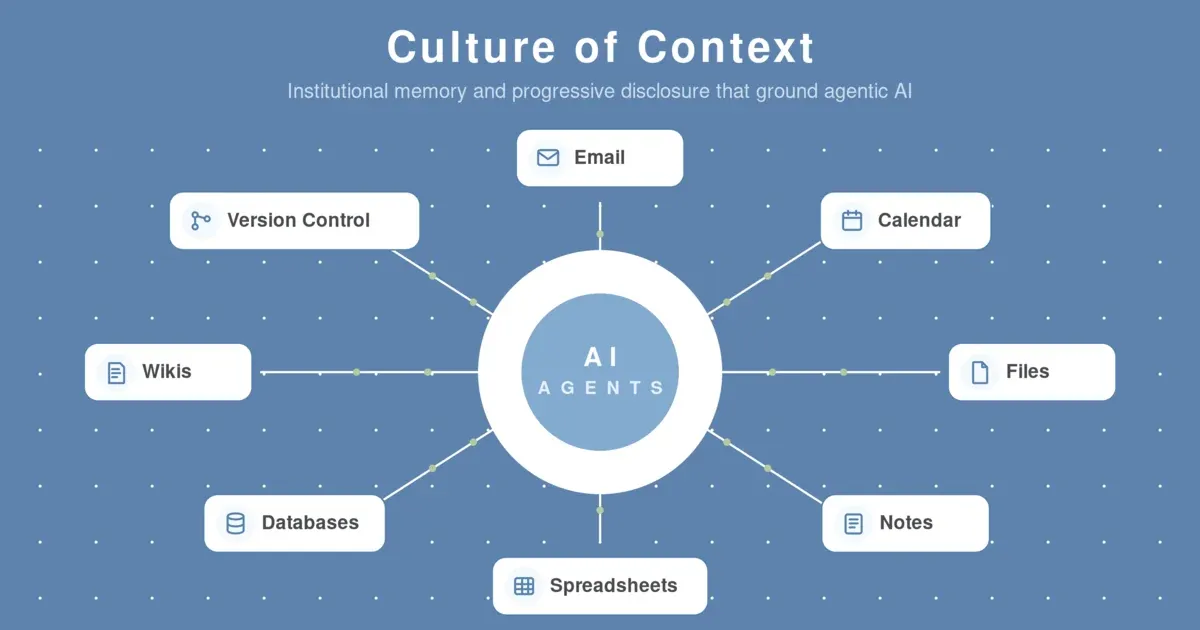
Context takes many forms. Context to guide agents on how to work is one, but of course there is the critical context necessary to do the work. This is your institutional memory.
If you are one person or a small business, institutional memory is context like this:
- Calendars
- Notes (e.g. Notion, Obsidian, etc.)
- Spreadsheets
- Documents (e.g. PDFs, Microsoft Word documents, etc.)
- Branding (e.g. logos, font files, etc.)
- Blog posts
- Version control
- Specs in Markdown for Spec-Driven Development
- Accounting platforms
For a larger company, institutional memory combines all of that with much more:
- Wikis
- Task trackers
- Observability platforms
- Databases
- Cloud storage
- SaaS platforms (e.g. Salesforce, Excalidraw)
- Chat platforms (e.g. Slack, Microsoft Teaams)
It is absolutely essential to make this context available to your agents. Analysts can do this with Claude Cowork connectors. Software engineers can configure AGENTS.md to run CLIs or configure Claude Code
to load MCP servers. If you build agents for customers using Embabel, LangChain, Mastra, or similar frameworks, it is essential to connect to context sources, typically over MCP, to help your customers
solve their problems. These frameworks make it easy and offer methods of progressive disclosure.
I left out one critical piece of context: agentic memory. I could say agentic memory is such a big topic that it deserves its own post, but in fact
it is such a big topic that it’s the subject of countlesss academic research papers. The relevant point here is that AI agents
need to learn from their mistakes. At its simplest, agentic memory could result from you revising a SKILL.md file because your first run of the skill
exposed a lack of specificity. For example, I once created a skill to generate a YouTube transcript and place it in a specific folder for subsequent ingestion
into my knowledge base, but in my head I assumed the output would be a Markdown file with an intuitive name. The funny thing is that is exactly what I got
the first few times, but for some reason I eventually got JSON named after the YouTube ID, which is jibberish. I revised SKILL.md to be explicit about what I wanted,
and that is agentic memory at the smallest scale. Enterprise agentic memory uses dedicated databases to enable agents to remember what worked and what didn’t.
Either way, agentic memory must also be an essential part of your context strategy.
The Hard Part for Businesses
The challenge for businesses, especially larger ones, is that their institutional memory is a mess. For one thing, they are missing a lot of it. Have you ever been in a meeting where no one knew the answer to an important question because the expert was on vacation or someone described contingencies in case the expert “was hit by a bus”? These are indicators that important information, vital context for AI agents, is in people’s heads rather than sufficiently documented because no one likes writing documentation.
An even worse problem is that the institutional memory you do have is siloed. I have worked with clients with multiple product lines that share customers, and they had no idea that Mary Smith in one database is the same Mary Smith in another database. Entity resolution problems like that have always been an issue, but AI makes them worse. Why is that?
To keep with the MCU theme, AI is like Dr. Erskine’s super soldier serum that turns Steve Rogers into Captain America. Both AI and the serum amplify what you already are. As Erskine puts it, “Good becomes great. Bad becomes worse.” If your strategic planning, data architecture, and engineering processes are already good, AI makes you great. If they’re not, AI makes things much worse, and this is the primary reason so many businesses fail at AI. A business that lacks the semantics to generate the context necessary to recgonize that Mary Smith is the same in both databases will find that agents become just as confused as humans trying to make sense of it all.
To improve your chances of success, start with business strategy. Don’t use AI out of Fear of Missing Out (FOMO). FOMO is not a strategy. Address a real business need. Have a plan.
Then focus on the data architecture. Zhamak Dehghani’s Data Mesh is the only posture that scales here. Treat data as products. The domain that owns the data, and therefore knows it best, builds data products and publishes them to the rest of the organization. This is in contrast to the overworked Master Data Management team trying to model the whole business in a data warehouse based on their own with their generalist knolwedge of every domain. Worst of all, because all analytics go through them, they become a bottleneck and single point of failure for the organization. Data meshes distribute the work to those who know it best, and data products allow analysts and AI agents across the organization to query them through standardized interfaces.
You can combine Data Mesh with Medallion Architecture to take things to the next level. Medallion features three kinds of data:
- Bronze for raw ingest, the source for any data analysis
- Silver for clean, row-level refinement
- Gold for curated aggregations reflecting common queries
Each business domain in a mature data architecture offers Broze, Silver, and Gold data products, and most importantly, they all enjoy robust data governance, which provides semantic meaning across products. In other words, governance expresses metadata as glossaries, catalogs, and ontologies in natural language. This is critical context for Enterprise AI to add value, and it is often called the “Knowledge Layer.” AI agents can query the Knowledge Layer for context about the underlying data sources and then reach into the data sources themselves for specific answers. This is progressive disclosure at enterprise scale, but you need the supporting architecture to make it work.
There are also open source and commercial vendors out there offering ways to derive existing data into new projections to augment the Knowledge Layer, for example by creating graphs across different data sources. Whatever approach you take, just keep in mind that Knowlege Layers are critical for agents to drive value at work.
I should also mention that making context discoverable and digestible by agents is starting to become so important that it is driving a whole new set of talking points around “Agent Experience,” even going so far as to claim that Agent Experience (AX) is more important than user experience (UX). I would be cautious about this latest hype train. This is the most important reason:
Nothing will ever be more important than user experience becuase no one will ever be more important than users.
The purpose of AX is to improve UX.
AX also is merely the evolution of systems interoperabilty, something software engineers have thought about for decades. The vision for agent swarms acting autonomously is cool, but it doesn’t mean discoverability, performance, resilency, and other key principles of systems interoperability are brand new ideas.
To be fair, there is an art to AX that is new because now AI agents are making decisions rather than if statements in code. After all, the premise for this post
is the importance of managing context to make your data available in the most usable way for agents, but I see AX as more buzzword than substance.
Tech sure likes its buzzwords. Speaking of which…
Context and Progressive Disclosure are the Antidote to Tokenmaxxing
Like most Silicon Valley fads, tokenmaxxing, the act of maximizing AI token spend as a signal of productivity and innovation, was always completely unserious and frankly embarrasing. Our goal should be to build cool software that makes the lives of our users easier and better, not to indulge ourselves in AI for the sake of it and an unwillingness to seek therapy. Uber and Amazon, one of the worst offenders in Big Tech, finally figured it out. On the bright side, if you have had trouble making AI work for you, maybe it helps to know that industry leaders who should know better are so easily susceptible to hype and nonsense that even they fail miserably.
If you want to use AI in a mature, serious way, you should consider tokens a precious resource like memory, processing power, and network bandwidth. This will save on costs to you and to the planet. Token efficiency starts with context. AI that veers off on its own without any guardrails wastes tokens. Context grounds agents and steers them in the right direction. However, too much context also wastes tokens. Combining context with progressive disclosure to control how agents work and guide them to the light at the end of the tunnel will maximize token efficiency.
It’s easy to be overwhelmed by all the new models, tools, techniques, and terms that emerge literally every day in the AI space. The anxiety is real. Rather than get caught up in hype, do yourself a favor. Focus on patterns around ways of working that transcend trends. Create a Culture of Context for yourself and your business to take the lead in AI.
If you are still wondering, Thor’s mother is Queen Frigga of Asgard.