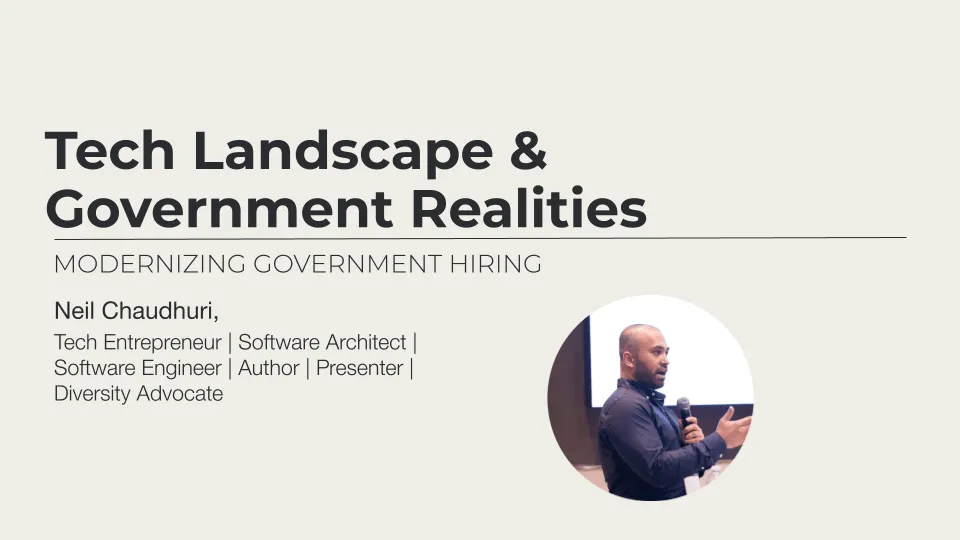
Modernizing Federal Technical Hiring at the White House
Vidya's founder gave a cohort of government recruiters a working playbook on Technology Day, delivered for Mediabarn.
- Client
- Mediabarn
- Sector
- Federal Government
The Challenge
Federal agencies spent decades outsourcing software product development to private vendors, and they eventually wanted that subject matter expertise back in house. Hiring stood in the way. Government job titles and career ladders mapped poorly onto what an engineer reads on a private-industry posting, so a strong candidate could not tell what the work involved or where it led. Agencies competed for attention against Big Tech at the same time, and a segment of elite talent regards Uber, Meta, Spotify, and Google as the lifelong dream job. Recruiters do not argue a dream away.
The industry playbook those agencies wanted to borrow carried its own defect. Commercial software hiring runs on the coding interview, an exercise that asks a candidate to whiteboard a doubly-linked list or a merge sort while a panel watches. A North Carolina State University and Microsoft study found that every woman who took a public technical interview failed, while every woman who took the same interview privately passed. An agency importing commercial practice wholesale would import that screen along with it and keep losing the engineers it set out to recruit.
Mediabarn engaged Vidya to make the case to the people who could act on it. The White House hosted Technology Day, and a cohort of federal recruiters made up the audience. Vidya’s founder delivered a talk titled “Tech Landscape and Government Realities: Modernizing Government Hiring.”
Vidya’s Approach
Vidya delivered advice on this engagement and wrote no code, so the recommendations carry the entire value and have to hold up on their own.
Recruiters win by choosing their ground. Vidya advised the cohort to stop spending effort on engineers who have already settled on Big Tech and to concentrate on the sizable population of elite talent that wants mission work. Those engineers understand that disabled people, elderly people, and veterans carrying the consequences of war depend on federal services that function. Agencies had meanwhile begun realigning job titles and career paths with private-industry norms, and Vidya showed examples of government leaders already doing it, because a posting a candidate can read is the cheapest fix on the list.
The interview itself needs replacing. Vidya recommends a structured conversation in which the interviewer opens by stating business goals, mission, and role expectations, then works through six questions. Ask candidates to walk through problems they solved at work, and follow those threads until the technical judgment shows. Ask what support they need to do their best work, which moves the burden onto the employer where it belongs. Vidya lays out the full set and the evidence behind it in why coding interviews are the worst. Teams that cannot abandon coding exercises have three humane adaptations available. Offer a choice between live coding and a short paid take-home. Hand candidates a real but non-critical problem drawn from actual work. Collaborate through the exercise with access to normal resources, including AI.
Culture decides whether the hire stays. Vidya described flow state as the foundation of good engineering work and showed how closely it hews to agile principles, then placed responsibility for creating flow state on management, citing Sarah Drasner’s argument that flow matters more than passion. Screening for passion through side projects and weekend commits filters for free time, and free time is a privilege. That same reasoning drives Vidya’s position that systems and leadership produce team results, which how sports busts a common myth about software engineering teams develops through decades of roster-building failures. Vidya closed by mapping product categories that industry and government both build, from websites to machine learning pipelines to AI, onto the roles suited to deliver each one, because a program office staffing an AI product needs a different mix of engineers than one staffing a website.
One limit deserves a plain statement. Industry has not mastered hiring in its own right, so no finished commercial template existed to hand the recruiters. Vidya argued instead for practices most commercial teams still ignore. Vidya also reports no hires made and no policy changed, because the downstream effect of a talk resists measurement once the applause fades.
What Changed
Federal recruiters left the session with language for a case many of them already believed. One attendee said afterward that he had held similar ideas himself but had lacked the vocabulary to present them to his agency’s leadership until he saw the presentation, and he left planning forward-looking changes to his own hiring process. That reaction is the honest measure available, and government software engineer recruiting changes one hiring manager at a time.
An agency ready to move on this can start with a single requisition. Vidya’s technology culture practice rewrites one position description and the interview loop attached to it, then runs the revised loop with the hiring manager on the next open role, so the program office compares applicant quality and acceptance rate against its standard process within one hiring cycle.
Results
Federal recruiter cohort briefed at the White House
Vidya's founder delivered "Tech Landscape and Government Realities: Modernizing Government Hiring" on Technology Day at the White House, an engagement Vidya performed for Mediabarn.
A recruiter gained language for his leadership
One attendee said he had held similar ideas for a while but had lacked the vocabulary to present them to his agency's leadership until he saw the presentation.
Engineering roles mapped to real product categories
The talk paired software product categories that industry and government both build, from websites to machine learning pipelines to AI, with the roles that deliver each one.
Frequently Asked Questions
What was Vidya's role in the White House engagement for Mediabarn?
Vidya performed this work for Mediabarn as an advisory and thought-leadership engagement. The White House hosted Technology Day and supplied the audience, a cohort of federal recruiters. Vidya's founder wrote and delivered the talk, and Vidya shipped no software on this engagement.
How does a federal agency modernize technical hiring?
Start with the artifacts a candidate actually reads. Align position titles and career ladders with the language private industry uses, so an engineer can tell what the job involves and where it leads. Then replace the coding interview with a structured conversation about real work the candidate has done. Federal technical hiring modernization fails when an agency copies commercial practice wholesale, because commercial practice still runs on the screen that costs agencies the candidates they want.
Why does Vidya argue against coding interviews for government software engineer recruiting?
Coding interviews measure short-term recall of computer science trivia and composure under observation. A North Carolina State University and Microsoft study found that every woman who took a public technical interview failed, while every woman who took the same interview privately passed. Agencies competing for White House tech talent cannot afford a filter that removes qualified engineers for reasons unrelated to the work.
Which hiring change should a program office make first?
Rewrite one position description and the interview loop attached to it, then run that loop on the next open requisition. A single requisition gives the hiring manager a controlled comparison against the agency's standard process within one hiring cycle. Vidya recommends measuring the change by who applies and who accepts, because those two numbers move before any org-wide policy does.